

Notte della Taranta and the Salento Summer You Dance Through
You do not hear the tamburello straight away. At first, it comes as a heartbeat in your chest; then you realise it is coming from a square two streets away. It is late August, eleven o’clock at night, and the tarmac is still giving off the heat of the day. A woman has brought her chair outside her front door. A young man runs past carrying two beers. Beneath the bell tower, someone has already begun to dance.
This is the Salento summer you do not simply watch: you dance it.
What pizzica really is — and why it is not picture-postcard folklore
To understand La Notte della Taranta, you need to go back a few centuries, to a rural world where women worked in the tobacco and wheat fields.
The legend — although it was far more than a legend — told of the bite of the taranta. The woman who had been bitten, the tarantata, would fall into a state of crisis that no doctor knew how to cure. The only remedy was music: musicians were called into the house, the furniture was moved aside and a white sheet was spread across the floor. They would play for hours, sometimes for days, until the body found release.
In the 1950s, the anthropologist Ernesto de Martino came here to study this tradition, eventually writing a book entitled The Land of Remorse. Even today, on 29 June, the chapel of Saint Paul in Galatina is a place people visit with a certain sense of reverence: it was here that the tarantate would come after a night of dancing.
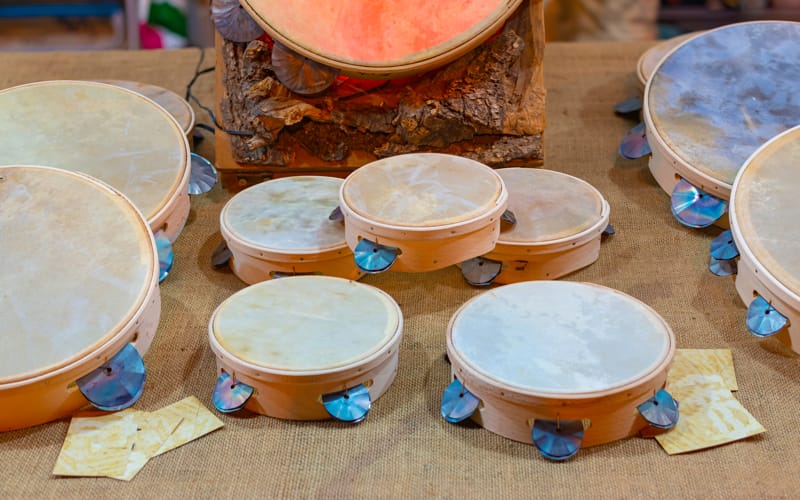
The pizzica was born from this ritual, and today it has two distinct forms. There is the pizzica pizzica, a courtship dance performed in pairs with a red handkerchief. Then there is the sword dance, known as scherma: a symbolic duel fought with gestures of the fingers, still performed throughout the night between 15 and 16 August in Torrepaduli, around the Sanctuary of San Rocco, until dawn.
The Melpignano Concertone: what to expect
The La Notte della Taranta Festival was founded in 1998 and travels through the villages of Grecìa Salentina every summer, in the area where Griko is still spoken: Corigliano d’Otranto, Martano, Sternatia, Calimera, Zollino and Martignano. For two weeks, free concerts fill the village squares, with grandmothers watching from their windows and café tables brought out onto the paving stones.
Then the final Saturday of August arrives, and everything converges on Melpignano.
The Concertone, or Grand Concert, takes place in the square in front of the former Augustinian Monastery. Admission is free, and the event can attract more than one hundred thousand people. On stage is the La Notte della Taranta Popular Orchestra — tamburelli, violin, button accordion and battente guitar — led each year by a different maestro concertatore, or musical director. Over the years, the role has been taken by artists such as Stewart Copeland, Ludovico Einaudi, Goran Bregović and Carmen Consoli, each bringing their own vision of how tradition can meet something new.
The result is never simply a concert of traditional music. It is something stranger and more alive: seven thousand years of drumbeats flowing into a symphonic, rock or electronic arrangement, while fifty thousand people dance the same dance at the same moment.
It usually ends at around three in the morning. For some, it lasts until dawn.
More than the taranta: a summer that carries on
In August, music can be heard throughout Salento. There are the authentic village festivals, where people eat beneath the decorative lights and the local band begins playing at nine: the puccia festival, the fried-fish festival and the municeddha snail festival in Cannole. There are patron-saint celebrations, with illuminations that transform an ordinary street into a cathedral of light. And there is the night of San Rocco in Torrepaduli, the oldest and least touristy celebration of them all.
Then there is Lecce, which stays awake until late throughout August. You do not need to travel far: you may hear the sound of a tamburello drifting from a courtyard in the historic centre, surrounded by the golden stone of Lecce Baroque architecture, with a glass of Negroamaro resting on the table.
Festival calendar
- Thursday 30 July – Corigliano d’Otranto: Opening of the touring festival
- Friday 31 July – Zollino
- Saturday 1 August – Calimera
- Sunday 2 August – Carpignano Salentino
- Monday 3 August – Cursi
- Tuesday 4 August – Sogliano Cavour
- Wednesday 5 August – Nardò
- Thursday 6 August – Alessano
- Friday 7 August – Galatone
- Saturday 8 August – Cutrofiano
- Sunday 9 August – Sternatia
- Monday 10 August – Torre Sant’Andrea, Marina di Melendugno
- Tuesday 11 August – Ugento
- Wednesday 12 August – Muro Leccese
- Thursday 13 August – Martignano
- Friday 14 August – San Cataldo, Marina di Lecce
- Sunday 16 August – Soleto
- Monday 17 August – Galatina
- Tuesday 18 August – Castrignano de’ Greci
- Wednesday 19 August – Martano
- Saturday 22 August – Melpignano: Concertone
- Sunday 23 August – Galatina: La notte delle ronde
Come and dance with us
Melpignano is just over half an hour away from here. The squares of Grecìa Salentina are even closer.
Just a few minutes from our hotel, you can set off for the Concertone and return late at night with the music still ringing in your ears, knowing that a leisurely breakfast and the sea, only twenty minutes away, will be waiting for you the following morning. When you visit in August, let us know: we will help you find your way through the dates, shuttle services and villages where the pizzica is danced without a stage.