

The Best Beaches Near Lecce: How Long It Actually Takes to Get There
There’s a precise moment, in Lecce, when you realise it’s time to head for the sea. It’s half past nine in the morning, the stone of the palazzi has already changed colour, and the air under the arcades is starting to thicken. Somewhere a shopkeeper pulls down the awning. You finish your iced coffee with almond milk, glance at your watch and think: how long will it take?
The honest answer is: it depends. But less than you’d think.
Lecce sits in an unusual spot for a Salento town. It isn’t on the sea — it’s between two seas. From Piazza Sant’Oronzo you can head east to the Adriatic or west to the Ionian, and either way you’ll be on the sand before the ice in your glass has fully melted. This piece is here to tell you how long it really takes — not what the sat-nav claims at six o’clock on an April morning.
The rule of the wind: how to choose the right coast in Salento
Before thinking about distances, there is one piece of advice that everyone here knows, but few guidebooks will tell you.
When the Tramontana wind blows from the north, it is best to head towards the Ionian coast. The sea on this side tends to remain calmer, sheltered from the wind and often smooth from early in the morning.
Santa Cesarea Terme and Castro are the exceptions: conditions there can be different, so it is always worth taking a look at the sea before settling under your beach umbrella.
When the Scirocco blows, however, you should change direction. Cross the peninsula and choose the Adriatic coast, where the water may be calmer and more sheltered on these days.
Crossing Salento at its narrowest point takes just under forty minutes. That is the real luxury of staying in Lecce: you can choose your coast according to the wind, switch seas halfway through the morning and still not lose the day.
The Adriatic coast: the sea of the Lecce locals
San Cataldo — 12 km, 20 minutes
This is Lecce’s own marina, where locals come for a swim after work. You reach it in a straight line along the road that cuts through the countryside, between dry-stone walls and dusty prickly pears. It isn’t the postcard Salento beach — and that’s precisely the point: low rocks, kids diving off the jetty, kiosks with cold drinks in chest freezers, and families who properly lay the table, tablecloth and all.
In summer there’s also a town bus from the centre — handy if you’ve left the car at the hotel.
Frigole, Torre Chianca, Torre Rinalda — 15-20 km, 25 minutes
Heading north, the coast softens into pale sandy beaches broken up by sixteenth-century watchtowers. Behind the dunes lies the Rauccio pine forest, where the air smells of resin and curry plant even at midday. These are long, windswept beaches — perfect if you’re after space and aren’t fussed about a picture-perfect sea.
Torre dell’Orso and the Due Sorelle — 30 km, 35 minutes
Here everything changes. A flawless bay, closed off to the south by two sea stacks that local legend tells of as two sisters who dived into the sea rather than be parted. Fine sand, water that shifts from green to blue within three metres. It’s beautiful and plenty of people know it: if you go in August, set off before nine or arrive after five, when the light drops and the beach empties out.
Sant’Andrea and the Grotta della Poesia — 30 km, 35-40 minutes
No sand here: this is white rock carved out by the sea, natural arches, little inlets you climb down into by ladder. The Grotta della Poesia, at Roca Vecchia, is a natural pool ringed by Messapian ruins. Well worth seeing — but see it early: by midday it’s a queue of people waiting their turn to jump in.
Baia dei Turchi and Otranto — 45 km, 50 minutes
The last beach before Otranto, reachable only on foot through a two-hundred-metre stretch of pine forest that smells of warm pine needles. Worth the extra distance, especially if you then stop in Otranto for sunset and dinner up on the walls.
The Ionian coast: white sand and shallow water
Porto Cesareo and Torre Lapillo — 35-40 km, 45 minutes
You cross the Salento interior, through olive groves and villages with squares left deserted at midday, and come out onto a sea that looks tropical by some geographical mistake. Shallow, warm water, a sandy bottom, the Isola dei Conigli a few strokes away. This is the ideal coast if you’re travelling with children: you can wade twenty metres out and the water is still at knee height.
Punta Prosciutto — 55 km, one hour
Dunes, junipers, dazzling white sand. One of the finest beaches in Puglia and, in high season, one of the busiest. Practical tip: arrive early or very late, and allow a few minutes’ walk from the car park.
Gallipoli and Punta della Suina — 40 km, 45 minutes
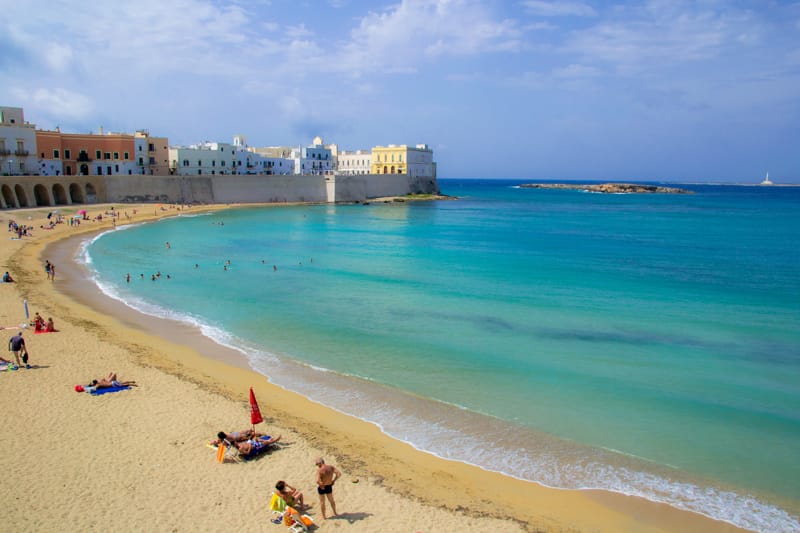
Gallipoli is two things at once: the old town out on its island, with the harbour and the fish stalls, and the beaches around it. Punta della Suina, just outside town, is a low rocky shore wrapped in Mediterranean scrub, with sandy coves tucked in between. You reach it on foot from a dirt car park; the air smells of myrtle and salt.
Pescoluse, the “Maldives of Salento” — 65 km, one hour ten
The nickname is a recent invention but the sand is the real thing: white, ultra-fine, with shallows that run out for tens of metres. It’s far, so treat it as a full day out: a swim, lunch, and on the way back a detour to Santa Maria di Leuca, where the two seas meet.
What the sat-nav doesn’t tell you
Three things learned the hard way.
The times above hold for June and September. In the second half of July and in August, add fifteen to thirty minutes, especially on the roads towards the Ionian and on the evening drive home.
Parking is often the real cost of the day: at Torre dell’Orso, Punta Prosciutto and Baia dei Turchi, budget for a few euros and a bit of a walk.
And if you don’t drive, there are the summer Salento in Bus services to the main resorts and the Sud Est trains to Gallipoli — and, with a change at Maglie, to Otranto: less flexible, but they do the job.
The drive back is the best part
There’s an hour, around seven, when you drive back towards Lecce with your hair still salty and the window down. The countryside darkens, the lights of the old town come up on Lecce’s baroque, and the city you left half-asleep is waiting for you with tables out on the street and the smell of freshly baked rustici.
A few minutes from our hotel, you can choose which sea to have each morning: the Adriatic before breakfast, the Ionian in the afternoon, and in the evening a stroll through the courtyards of Lecce. We’ll be here to help you decide — and to tell you, day by day, which way the wind is blowing.