




Pasticciotto for Breakfast: Lecce’s Unwritten Rule
You smell it before you see it. You walk into the bar just after seven, the shutter still half down, and from the back comes a warm scent of butter and custard that stops you in the doorway. The barista doesn’t even ask what you want. He takes a pasticciotto from the tray just out of the oven, sets it on a small plate and slides it towards you. It’s still warm. This is how a morning in Lecce begins.
Here the pasticciotto isn’t a pastry. It’s a way of waking up.
What it is, and why it’s more than a pastry
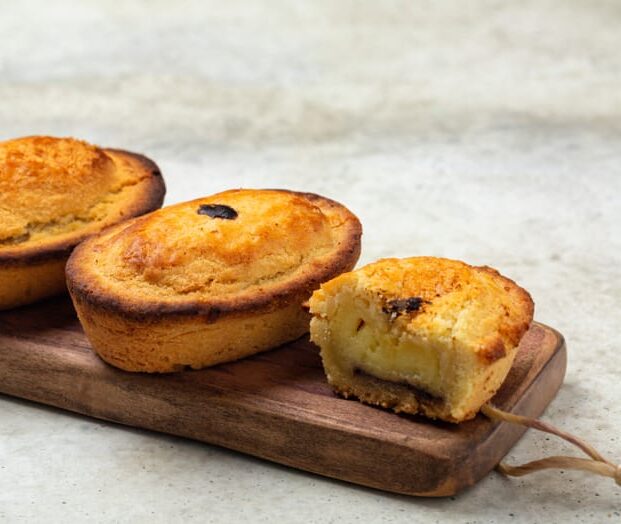
Picture a shell of shortcrust, golden and glossy, about the size of your palm. Inside, warm custard, thick in just the right way. The shape is oval and slightly domed, like a small egg. The base is thicker, the top smooth and faintly amber.
Temperature is what makes it. The pasticciotto is eaten fresh from the oven, when the pastry is still fragrant and the custard at its centre still holds the heat of the bake. Cold, it’s a different sweet: good, but another thing entirely. That’s why the bars of Lecce bake in waves all morning long, and why those in the know turn up early.
A rule nobody explains
No one in Lecce will ever tell you out loud that the pasticciotto belongs at breakfast. It simply does.
You read it in the gestures. The workman who stops at the counter at half past six, coffee and pasticciotto downed in three minutes before his shift. The women who, after Mass, sit at a table and order one each with a cappuccino. The students who grab one to go, wrapped in a paper napkin that stains at once. It’s the ritual that binds the whole city together before the day truly starts.
There’s only one warning worth passing on: the pasticciotto fills you up. One is a full breakfast. Two is an ambition.
The legend of Galatina
The story leads to Galatina, about twenty minutes from Lecce, and to a date the local pastry chefs repeat with pride: 1745.
As the tale goes, in a pastry shop in the town — the Ascalone — a young baker, faced with leftover shortcrust and custard, put them together in small portions so nothing would go to waste. The result was such a hit that it became a sweet in its own right. The name, they say, was born from the delight of the first bite: this is an excellent little pasticcio. Legend or not, the Ascalone pastry shop still exists, and in Galatina you eat the pasticciotto with the feeling of being at the source.
From there the sweet won over all of Salento, and today it’s one of the most recognisable symbols of the local culture, alongside the rustico and the puccia.
Varieties worth trying
The classic is, and remains, the plain custard one. But within a few counters you can meet several versions.
- The fruttone, or black-cherry pasticciotto, with a dark drop of sour cherry beneath the custard that gives it a tart edge.
- The version with custard and a whole black cherry sunk into the centre — the most common after the classic.
- The modern reinventions of some pastry shops: pistachio, chocolate, gianduia. Delicious, though an old-school local will raise an eyebrow.
The advice, the first time, is not to overthink it: custard, warm, with a coffee. The rest comes later.
Where and when to stop
You don’t need a precise address. In Lecce the historic bars of the old town bake them every morning, and you’ll find excellent ones in the neighbourhoods off the tourist trail too, often at a fairer price and with the right kind of queue — locals.
The practical rule is a single one: follow the oven’s timing, not the tourist’s. Ask at the counter when the next batch comes out and plan around it. A pasticciotto eaten at eight and one eaten at eleven tell two different stories of Lecce.
And if you find yourself in Galatina, walk on to the main square: pairing the legend with the first bite is a small luxury that costs a few minutes of road.
