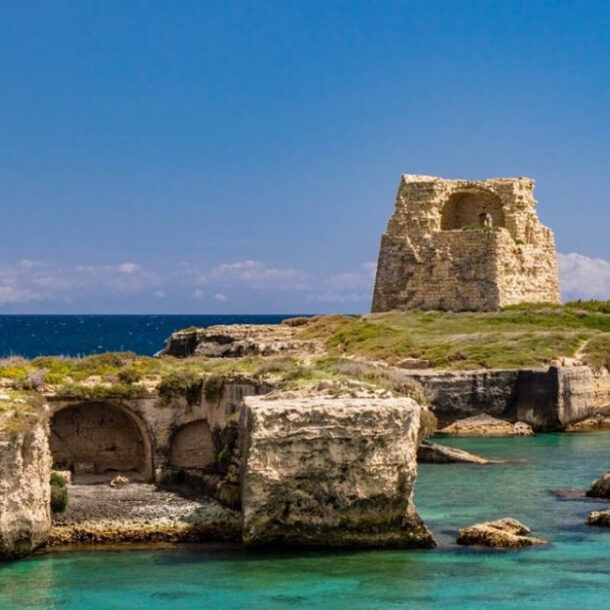


From Grove to Mill: How Extra Virgin Olive Oil Is Made in Salento
There’s a light that only Salento has in November. Low, golden, slipping sideways through the branches to catch the silvery green of the olive leaves. The air is cool and smells of turned earth and woodsmoke. Among the trees, spread on the ground, are the nets. And onto those nets, one after another, the olives fall.
It’s harvest season. The moment a tree becomes a bottle. And the moment you understand that extra virgin olive oil — the real thing — is far more than a condiment: it’s a whole year of work coming down to a few decisive hours.
The grove: when and how the olives are picked
It all begins in the Salento countryside, among dry-stone walls and trees that in some cases carry centuries on their shoulders. The harvest starts in autumn, usually between October and December, and colour decides the right moment: the olives are picked at veraison, when they turn from green to purple and the oil inside is at its finest balance. Too early and they yield little; too late, and the fruit loses its fragrance.
The gestures are the ones they’ve always used, updated just enough. Nets spread beneath the canopy. Mechanical shakers that set the branches trembling, or hands combing the lower boughs. Crates filling up, the sharp scent of broken leaves, the morning cold numbing your fingers. Those who work well pick and bring to the mill the same day, because olives left too long in the sack heat up and ruin everything.
The mill: where the oil is born
Then there’s the mill, the frantoio, and a smell like no other: grass, almond, artichoke, an intense green that fills your head the moment you step inside.
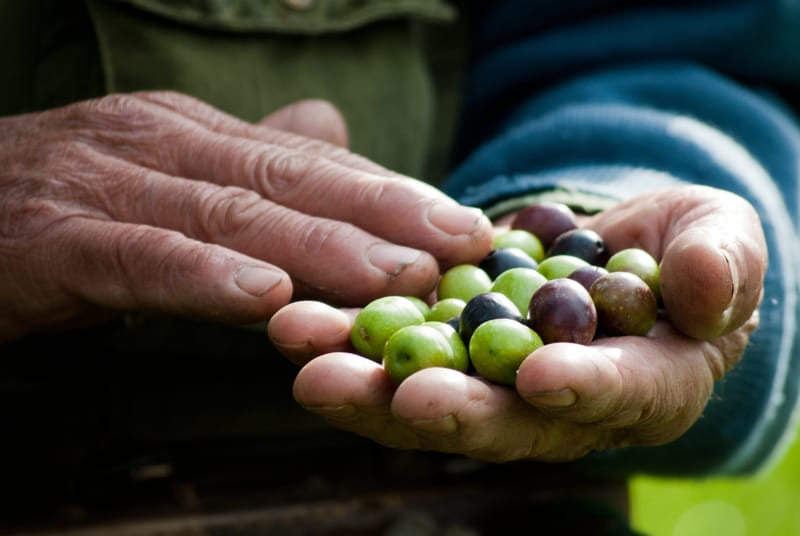
The olive’s journey, in a few stages, goes like this. First de-leafing and washing, to remove leaves, twigs and soil. Then crushing, where the olives are broken down, stone and all, into a paste. Next comes malaxation: the paste is worked slowly, never going above twenty-seven degrees, so the tiny droplets of oil can join together. This is the silent heart of the process, the part that decides how much fragrance will end up in the bottle. Finally extraction, where a centrifuge separates the oil from the water and the pulp.
What comes out is a dense, cloudy liquid, a green that hardly looks real. Tasted right there, freshly made, on warm bread, it has a tickle at the back of the throat that surprises anyone new to it. That tickle isn’t a flaw: it’s the sign of polyphenols, the antioxidants of young, healthy oil.
What makes an oil truly extra virgin
Not every olive oil is extra virgin. There are precise rules behind that word.
The oil must be obtained by mechanical means only, without excessive heat and without chemicals: this is what’s meant by cold extraction. Its acidity must stay very low, below 0.8 per cent. And on the palate it must have no defects, only the fruity character of a sound olive. Three conditions that, taken together, separate an ordinary oil from a true Salento extra virgin.
The area’s traditional varieties have a recognisable character: Ogliarola salentina and Cellina di Nardò give intense oils, boldly fruity, with that bitter, peppery note considered here a virtue rather than a fault.
The olive trees of Salento and their rebirth
You can’t tell the story of this land’s oil without telling the story of its trees. And, in recent years, their hardest chapter.
Since 2013 a bacterium, Xylella fastidiosa, has struck the Salento olive groves hard, causing the die-off of millions of trees, many of them centuries old. Entire landscapes have changed, and with them the lives of families who had farmed olives for generations. It’s a wound still open, and it’s right to tell it without dressing it up.
But for a few years now the countryside has been sending new signals. In several parts of Salento, some affected trees have begun to flower and bear fruit again, the spread of the infection has slowed, and large replanting projects have started with more resistant varieties, such as the Leccino. Rows of young olive trees are returning alongside the ancient trunks. It isn’t a victory, and no one here calls it that: it’s, quite simply, a land that refuses to give up. And every bottle of Salento extra virgin olive oil today is also a way of supporting those who never stopped farming.
We’ll be waiting among the olive trees
There’s a way to truly understand Salento, and it runs through a taste of freshly milled oil, with the bread still warm and the golden November light in the branches.
A few minutes from our hotel are the mills where all of this happens, and the countryside where the ancient olive trees stand beside the newly planted ones. We’ll be here to point you to where you can follow the milling, where to taste, and where to take home a bottle that tastes of this land and its will to be reborn.